Ashley M. Mosgrove, LCSW
WHO I AM
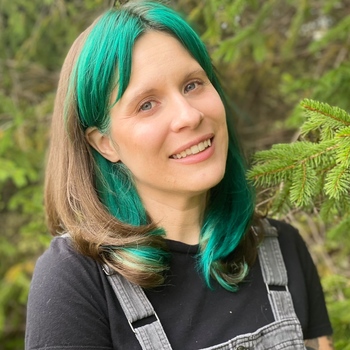
My name is Ashley (she/her). I am a Licensed Clinical Social Worker (LCSW) with over 15 years of experience working with individuals, couples, and families across a range of settings. My areas of specialty include trauma, neurodivergence, women's issues, and LGBTQIA+ affirming care.
I am not a blank slate therapist. I have a personality and a sense of humor. I bring my full presence to this work with appropriate boundaries and genuine care.
I am an active participant in my own healing and growth and have personal experience with a variety of healing modalities outside of traditional therapy. I would never ask a client to do something I wouldn't be willing to try myself.
Outside of the office you'll find me with my human and animal companions, in nature, playing video games, watching bad reality tv, and listening to an eclectic mix of music ranging from indie, folk, and grunge to hip hop, pop, and showtunes.
WHO I WORK WITH
I work with adults who have done the foundational work and are ready to go beneath the surface. I work best with people who want an equal partnership in their healing — those who are willing to look honestly at their patterns and take accountability for their growth and evolution, who are ready to explore and integrate all parts of themselves: their past, their present, and the person they want to become.
MY APPROACH
Much of what we believe to be our own thoughts, stories, and behaviors are actually adaptations — responses to trauma and to systems that benefit from our disconnection. A person cut off from themselves does not know their own power and often struggles to feel effective in relationship and community.
My approach draws on trauma-informed practices, depth psychology, attachment theory, somatic awareness, and Internal Family Systems (IFS) — all pathways back to yourself. The ripple effect of that homecoming reaches further than you think — into your relationships, your communities, and beyond.
Our work together may involve rebuilding connections — to yourself, to others, and to the natural world. Art, nature, play, spirituality, your own interests, values, and beliefs are woven in to create a personalized experience — moving at a pace that works for your nervous system.
* All therapeutic work begins with one to two 50-60 minute individual intake sessions, establishing history, needs, and goals.
INTENSIVE OFFERINGS
Sometimes weekly therapy isn't the right fit — whether because of time, schedule, or the depth of work you're ready to do. Intensive offerings are designed for people who want to go deep and move with intention. They are available for individuals, couples, and parenting work.
Sessions are 3 hours, typically once a month, and follow a consistent structure:
Hour 1: identify and flesh out the core focus
Hour 2: targeted psychoeducation and skill building
Hour 3: processing and integration
During hour 3 we create a plan for continued integration — which may include readings, practices, and the option for time-limited check-ins to keep the work alive.
- Intensive Couples Therapy
Before we ever sit together as a couple, I meet with each partner to understand your individual histories, needs, and patterns. From there we go deep into what's actually happening beneath the surface — the dynamic, the pattern, the place where things keep getting stuck.
- Intensive Parenting Work
You've read the books. You've tried the strategies. You love your child fiercely and you're exhausted in a way that's hard to explain. Maybe there's a lot of conflict, disconnection, or behavioral concerns that you can't seem to get a handle on. Maybe you're parenting a child who is neurodivergent, navigating mental health challenges, or carrying trauma. You may feel judged — by teachers, other parents, even your child's therapist — and no one seems to see how hard you're actually trying.
Here's what I believe: the most important work happens in you first. Before we talk about your child, we talk about you — your own history, your inner child, the patterns you inherited, the parent you want to be versus the one who shows up when you're overwhelmed. This isn't about blame. It's about giving you access to yourself so you can give your child what they need.
KETAMINE-ASSISTED PSYCHOTHERAPY (KAP)
All of the work described above — reconnecting to yourself, shifting old patterns, rebuilding connections — sometimes requires access to material that is hard to reach through talk alone. Research shows that ketamine temporarily increases neuroplasticity — the brain's ability to form new connections and patterns. This window of openness, combined with therapeutic support, can help remove subconscious barriers that get in the way of change and create an opening to try new behaviors and skills that have previously been difficult to access through talk therapy alone.
*I work in collaboration with Journey Clinical, a licensed medical provider that oversees the prescription and medical components of KAP.
.
Ashley M. Mosgrove
LCSW
